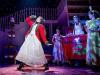
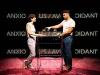
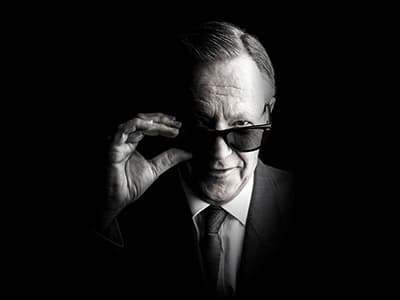
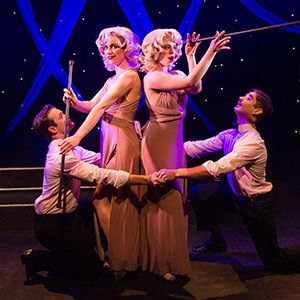
 Left – Joshua Mulheran, Laura Bunting, Kerrie Anne Greenland and Gabriel Brown. Cover – Berynn Schwerdt and company. Photos – Kurt Sneddon
Side Show is an entertaining musical which walks a curious tightrope between being conventional and offbeat, intrinsically subversive yet surprisingly mainstream, and can’t quite seem to decide on which side of the fence it wants to fall. The subject matter is self-evidently unconventional, certainly, and yet much of the narrative execution and thematic emphasis comes across as overly safe, even somewhat rote.
The show loosely dramatises part of the careers of real-life “Siamese” conjoined twins Daisy and Violet Hilton, who were plucked out of exploited obscurity as sideshow freaks to temporarily enjoy considerable fame on the Depression-era vaudeville circuit before Hollywood came calling, yet their exploitation arguably never really ceased so much as changed hands. So, naturally, the topics of fame and personal agency wrapped up in freakshow voyeurism during less-than enlightened times in America’s history might seem like a quirky basis for an edgy musical, and likely to fit in the mould of the more fringe or alternative side of the genre. Yet what is actually presented is in many respects an unexpectedly conventional melodrama, which predominantly focuses on unrequited love, romantic triangles, and our heroines trying to resolve their feelings on who are the right men for them.
Well… perhaps not entirely. This is a bit of a spoiler, but to give the show due credit, there is a double twist of sorts to these conjoined twins’ affairs of the heart, which somewhat mitigates the extent to which more than half of the show’s runtime seems chiefly concerned with their love-lives. Without exactly giving away how the story concludes, there is more than a bit of the star-crossed lovers trope in this tale, in which potential pairings fall afoul of contemporary social mores. Portraying these fraught couplings can ultimately be read as demonstrating that being in either a homosexual or interracial relationship in 1920s America was considered even more freakishly beyond the Pale than one’s status as a literal “sideshow freak”. This, if anything, is perhaps the intended subversive message of the narrative, to make the point that our prejudices and perceptions of what is “unnatural”, especially when it comes to non-normative body image and romance, has changed a great deal in the last century, at least when compared to most of the enlightened world today.
Therein, however, lies another difficult example of how this show appears to want to have its cake and eat it too – seemingly striving to be quirky, progressive, and push the envelope, yet also be a very all-ages, “family-friendly” fare in the conservative sense, as mainstream musicals tend to be framed. The largely erstwhile taboos of gay and interracial pairings are presented in a context in which the audience is clearly intended to sympathise with and approve of such orientations, and feel disquiet or even revulsion at the prejudices levelled against them, yet at the same time the musical is oddly coy about addressing these themes explicitly. The extent to which homophobic or racist sentiments are uttered onstage is practically nonexistent, and the treatment of these desires seems curiously underplayed in their intensity, especially considering their eventual respective significances to the main plot.
This coy treatment treads lightly to such an extent, in fact, that these themes flirt with falling into the category of subtext. Indeed, afterwards my theatre companion raised the question of whether the implication was that one of the characters in question should actually be interpreted as gay, such was the level to which the play avoided overtly stating its intent. And while the interracial love angle came across less ambiguously to her, this was similarly questioned for being woefully undersold throughout much of the story, given its ultimate narrative importance to the climax. While I myself was in no such doubt on either front, I did find it persistently odd and eventually irksome that the presentation was pussyfooting around these issues towards which they were seemingly trying to take a progressive and supportive stance. It felt almost as though the creators Bill Russell and Henry Krieger were second-guessing the extent to which such prejudices were indeed still prevalent amongst modern musical theatre audiences and were counterintuitively concerned about alienating conservative patrons – or, heaven forbid, young people! – with “inappropriately” frank portrayals of so-called “adult themes”. Perhaps it is a symptom of being an almost 20-year-old musical (albeit one revised in 2013), making this critique potentially a somewhat unfair rattling of the “social justice warrior” sabre. Nevertheless, the final result did seem, politically at least, flirting with a regressive timidity in the gulf between its apparent intent and execution.
All that said, however, this is by and large a highly entertaining musical. It opens strong with the introduction of the sideshow from which the Hilton Sisters were discovered, and although the increasing focus on romantic melodrama as the show heads into its second act may disappoint some, the framework of their rags-to-riches story is engaging and adequately layered to maintain interest. While perhaps none of the tunes are showstoppers destined for greatness, Russell and Krieger’s songs are catchy and smoothly integrated, and the characters are generally well-drawn and engrossing.
The strength of this production displays talent far outstripping its modest scale and production values. The energy and pizzazz of the ensemble seem almost unable to be contained by the intimate venue of the Hayes Theatre, playing it to the not-so-distant rafters as befitting a more illustrious staging. Ably directed by Richard Carroll with serviceable scenic design by Lauren Peters and lavish costumes by Angela White, the cast is a uniformly strong collection of “triple-threat” actor-singer-dancers. This highly-engaging troupe manage to squeeze several quite impressive old-fashioned musical numbers onto this tiny stage, and really create the illusion that the grimy carnival freakshow has given way to lavish stage of grand vaudeville set-pieces.
The twin leads Laura Bunting and Kerrie Anne Greenland as Daisy and Violet respectively are especially excellent, truly anchoring the show with their strong harmonies and duets with both each other and their respective love interests. The script makes much of the identical twins having starkly contrasting personalities, and this certainly helps one’s theatrical suspension of disbelief, considering that these talented actresses are, of course, by no means spitting images of each other. Bunting coquettishly plays up to Daisy’s ambitious, world-weary vivacity, while Greenland is equally perfect as the shyer, more emotional Violet, who pines for the normal life that is beyond her grasp. They are charismatic and sympathetic leads who contrast and play off each other well and, it must be said, do an excellent job of the surely deceptively difficult task of delivering their at times elaborate choreography whilst maintaining the pretense of being conjoined. And they do so despite their costumes seemingly incorporating nothing to physically bind them together, apparently relying alone on their practiced coordination to stay in constant contact.
Although the rest of the cast is also very strong, of particular note is Berynn Schwerdt as “Sir”, the twins’ exploitative surrogate father and ringmaster-like owner of the freakshow they grew up in. His riveting performance is repulsive yet seductive, being clearly the best outright actor in the production. Although his character recedes into the background early on, he leads the musical’s memorable opening number and very much starts the show off with a bang.
Apart from being marred towards the end by some severe technical difficulties from loud, ugly audio feedback (and one must wonder about the absolute necessity of using body-mics in such a small venue), this is a slick, generally well put-together production which belies its modest presentation with overflowing talent from the cast, infusing the show with a sense of vitality, fun and earnestness that elevates the final product above the shortcomings of the material.
One Eyed Man Productions in association with Hayes Theatre Co presents
SIDE SHOW
book and lyrics Bill Russell | music by Henry Krieger
Director Richard Carroll
Venue: Hayes Theatre Co | 19 Greenknowe Ave, Potts Point
Dates: 23 September – 16 October 2016
Tickets: $68 – $49
Bookings: hayestheatre.com.au | (02) 8065 733